Budgets Are Boring! 5 ways to spend less without one.
If you hate budgets and budgeting and find it sooo boring, how can you easily cut your spending?
Here are five ways to save without tracking every transaction:
Review your subscriptions – Your fixed outgoings are the easiest way to cut back: big outgoings like your insurance, power, phone and entertainment subscriptions. If you can reduce or eliminate even a few of these, you’ll make an immediate difference to your spending.
Embrace low-cost social activities – A night of drinking and dining out is fantastic fun, but it’s also costly, so try to make it an occasional treat. Instead, check out the free and cheap activities in your area and swap an expensive night out for a more cost-effective option.
Have a zero spend day – Pick one day a week, or one day each fortnight, and try to spend nothing. Make your own food and coffee, stay away from the shops and don’t add anything to your cart.
Plan your meals – Groceries have shot up in price over recent years. Planning your meals for the week and shopping accordingly means you can spend less and buy fewer takeaways.
Pay yourself first, then live off what’s left – Pay a realistic amount into your investments, savings or debt reduction first, advises the author of Automatic Millionaire. Then pay your commitments, like the utilities. Whatever is left over, live off that. If you’re not sure how much to pay yourself, we can help.
Confession Time… We Love Budgets!
We actually love budgets, even though they have a boring reputation. They’re part of the spreadsheet family, and you know that spreadsheets are close to our hearts.
While you can save money without a budget, if you embrace one it can turbocharge your success. There are apps to make it easier and support your saving goals.
So whether you want help with saving, or a budget for your personal life or your business, we can definitely give you a hand. Get in touch, we’d love to hear from you.
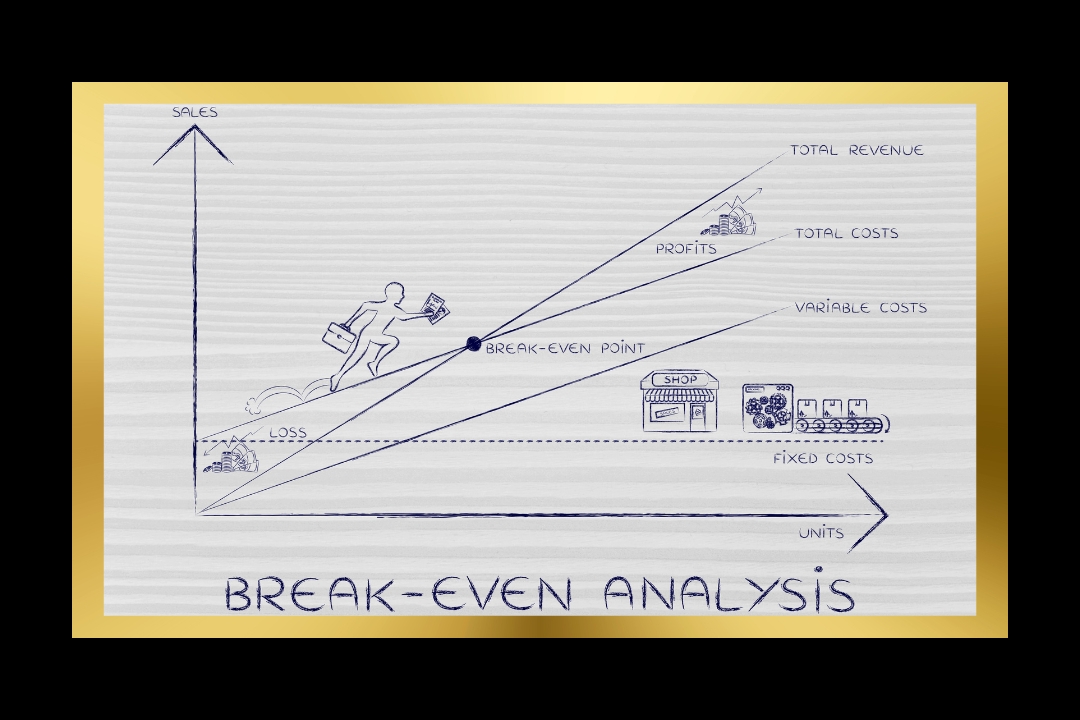
Understanding your business breakeven point is essential to know how much money you need to make to stay in business. It can therefore help you make well-informed financial decisions and practical business plans.
The breakeven point is the income or sales needed to cover all costs. Any earnings above this point generate profit. So your breakeven point tells you the minimum sales required to continue operating a viable business.
Understanding the breakeven point in conjunction with financial reports can give you valuable data to analyse fixed and variable costs and set sales targets for the business or individual staff members.
Fixed and Variable Costs
Fixed costs – remain the same regardless of how many sales you make. Expenses like rent, equipment lease repayments, or full-time staff must be paid whether you sell any goods or services or not. Fixed costs are often called overheads.
Variable expenses – (sometimes called production costs) fluctuate based on sales. For example, the cost of goods sold, production labour, and commissions paid to salespeople will vary according to the number of goods or services sold.
It’s helpful to work out an amount or percentage of variable costs compared to the sale price of your products or service. This may not be exact initially, but even if you get a rough figure to work with, this will help calculate your breakeven point. Over time as you analyse your financial reports, you’ll be able to refine the calculation and adjust your selling price accordingly.
How to Calculate Breakeven
You’ll need to know your fixed costs (overheads), selling price, and production costs.
One common method of calculating breakeven is as follows:
Overheads / (selling price – production cost)
For example, let’s say monthly overheads (rent, vehicle lease, administration staff) are $20,000, and you sell a coaching program for $3,000 with variable costs (coach fees, handout materials for participants, advertising) of $1,500 per program.
$20,000 / ($3,000 – $1,500) = 13.33
You would need to sell over 13 programs per month to break even, which equates to $40,000 worth of sales.
If the same program had variable costs of $1,800, you would need to sell 17 programs per month to generate $50,000 worth of monthly sales just to cover costs. Variable costs of $1,000 per program would mean you only need to sell 10 per month to break even.
With these examples, you can see how important it is to understand your fixed and variable costs. Then you’ll know exactly how much you need to make to remain in business and the resulting impact on your financial position. Once you have a reasonably accurate breakeven figure, you can quickly calculate your profit before tax for sales above the breakeven point. In the example where variable costs are $1,500 per program, let’s say you sell 20 programs each month. This would result in an extra $10,000 in profit (before tax) after paying for overheads and variable costs.
Can breakeven help with your pricing?
Understanding your breakeven point can give you some deep insights into your selling prices, helping you understand if they’re realistic.
For example, if your variable costs are high, how much more income will you need to reach breakeven? Is there a fair price for consumers that covers your expenses in a reasonable time frame? Do you need to raise prices to account for fixed and variable costs accurately?
Talk to us about calculating your breakeven point
There are different ways of calculating your breakeven point to confirm the viability of your business and the ideal pricing point for driving both sales and profitability.
We’d love to help you understand your business financials in more depth so that you can plan for long-term sustainability, enjoyment, and profitability.
Starting from the 2023 financial year, there are new rules for keeping records and calculating deductions for people who are working from home. There are now two ways to work out your deductions: the actual cost method and the revised fixed rate method. The revised fixed rate method has been changed to make it easier for people to calculate their expenses and avoid complicated calculations.
Using the revised fixed rate method, you can claim 67 cents for every hour you work from home. This covers things like; electricity, gas, phone and internet usage, computer consumables, and stationery. You can also claim the work-related portion of any equipment you bought for your home office, like furniture or technology.
You don’t need to have a dedicated home office space to use the revised fixed rate method, and businesses that operate from home can also use it to claim home-based business expenses.
To use the revised fixed rate method, you must keep a record of the total number of hours you worked from home, as well as evidence that you paid for the expenses covered by the fixed rate method, like phone or electricity bills. You also need records for any equipment you bought to work from home.
Please feel free to download and use the document below to record the hours you worked from home.
New rules for tax deductions on working from home expenses from the 2023 financial year.
Dedicated workspace no longer required to claim deductions.
Depreciation on work assets such as office furniture and technology can be claimed.
Two calculation methods are available: actual cost method and revised fixed rate method.
Revised Fixed Rate Method Highlights
Expenses covered under the revised fixed rate method: electricity, gas, phone, internet, computer consumables, and stationery.
Rate for revised fixed rate method increased from 52 cents to 67 cents per hour worked from home.
Businesses that operate from home can also use the revised fixed rate method.
To use revised fixed rate method, records of hours worked and expenses.
If you have worked from home during the 2024 financial year, contact us to discuss your situation further as you are likely to be affected by the above changes.
Additional Resources:
ATO Instructions for claiming deductions using the revised fixed rate method or actual cost method, click here.
Transforming into a digital and cloud business sets the best possible infrastructure for future growth. And, as your business scales, the benefits of going digital will become apparent.
Running your key business processes in the cloud and using the latest digital software and apps adds to your efficiency and productivity. And most importantly, digital systems are designed to scale with you as your enterprise grows and the need for resources increases.
Here are some significant reasons for taking the plunge and diving into digital.
Automate your key manual process to increase efficiency
A scalable business has to systemise its processes and procedures. Is your business model still tied to manual processes and a system that only exists in the owner’s head? If so, you’ll eventually come up against a capacity brick wall. Therefore, systemising and automating your processes is a fundamental step when you jump to digital.
Look at every internal and external step in your operations and write down how these systems work. Note down each task, who actions what, and how the whole system links in with the next step in your operational chain. If there are opportunities to automate a step, automate it. Many business apps now include artificial intelligence (AI) or automation features that can chase up unpaid invoices, send automated replies to customers in live chats, or take automatic payments, etc.
Work in the cloud to stay more connected
Since the start of the 2020 pandemic, the world has seen a quantum shift to remote working – and that’s only been possible because of cloud technology. Instead of working from local applications on our laptops or office-based servers, most tech-savvy businesses now use cloud-based apps that are accessible anywhere you have an internet connection.
Switching to cloud-based systems is a game-changer. You and your team are no longer tied to a physical office and can be productive from any WiFi-enabled location. That could be your home, customer’s warehouse, regional office, or local coffee shop. And the benefits aren’t just limited to remote working. With your applications and databases in the cloud, you can access customer information, sales data, or financial numbers wherever you happen to be. Everything is securely backed up and available at the press of a button – that’s an invaluable benefit if you want to be flexible, connected, and scalable as a business.
Create your own custom app stack
Your business systems and software no longer have to remain static and based on the office server. By combining a business and accounting platform like Xero, MYOB, QuickBooks, or Sage with your own choice of business apps, you can create a truly tailored ‘app stack’.
Apps use an API (application programming interface) to connect with each other, share data and form a more extensive business system. This can include apps to:
Manage and automate your bookkeeping and accounting tasks
Send out e-invoices to your customers to speed up payments
Take automated payments and reconcile your transactions
Automatically chase late-paying customers and carry out credit control duties
Project manage your operations and provide detailed reporting
Manage your job utilisation and time spend on each project
Keep a detailed real-time inventory of your products
Send out marketing campaigns and social media posts to your audience
Interact more closely with your end customers and learn their habits
Record and track your business data
App integrations and a customer app stack don’t just improve your productivity. Because your apps are connected via APIs and share your business data, you also have access to a wealth of data, information, and reporting features.
Look in detail at your cash flow, expenses, and spending to improve your cash position. Take a deep dive into your sales and marketing information to determine your best (and most profitable) customers. Run projections and ‘What if…’ scenarios based on your historical data to forecast the future path of the business. There are plenty of ways to use this bountiful data to help you review, understand and improve your performance as a company.
Make better-informed business decisions
A business in the pre-computer age would have had very little information on which to base its decision-making. Annual accounts, cash flow statements, and some basic management information would have been available, but there was very little real-time data to refer to.
In the digital age, you can see every aspect of your company’s performance in real-time – and, in some cases, in the future. That’s a game-changer and something every business owner should use to improve strategy, financial management, customer experience, and business decision-making.
To summarise, a digital business:
Creates systems that are integrated and connected
Shares and records all your business data
Reviews, analyses, and finds insights into your business information
Connects with your customers in more meaningful ways
Makes better-informed business decisions as a result.
Get in touch to discuss embracing cloud tech and a digital business model.