International Business in Australia – When to Register for GST
Does your international business make sales in Australia? You may need to register for Australian goods and services tax.
Like many countries, Australia charges a goods and services tax (GST) on most products and services sold within Australia. Australian GST is a tax of 10% added to the price of goods and services.
Any business that makes sales within Australia needs to consider whether it should be registered for GST and include GST in its prices.
Suppose your business does need to register for GST. In that case, it must submit a business activity statement (BAS) to the Australian Taxation Office (ATO) and pay the GST amount.
When should an international business register for GST?
If your business makes sales of AUD $75,000 or more per year (or $150,000 if it’s a non-profit organisation) you must register for GST with the ATO.
There are some exemptions to registration, and you’ll also need to assess your GST turnover. Not all income is included in the GST turnover threshold.
Some examples of goods and services that can incur GST include digital products. Such as ebooks or training courses, professional advisory or consulting services, and personal products such as clothes or jewellery.
Overseas businesses can choose from simplified or standard GST registration, although there are criteria for simplified registration.
Australian business owners can check the ABN Lookup website to see if an overseas supplier you interact with is registered for GST. Remember, you can only claim GST on expenses if a GST-registered business has correctly charged it. And if you provide your ABN to a GST-registered overseas business, they do not need to charge you GST for business purchases. So check that you’re not claiming GST incorrectly by inspecting the invoices provided by the supplier and the ABN Lookup.
If your international business transacts in Australia, we can help determine if you should be registered for GST in Australia. We can also inform you about the invoicing requirements and the BAS process.
Having proper control of your business finances is a big advantage. It helps you make well-informed business decisions and keeps your organisation profitable.
With so many digital tools for managing your bookkeeping, accounting, and management reporting, it’s never been easier to manage, track and forecast your financial position.
But what are the primary tools you need? And how do you set up your financial systems, apps, processes and reporting to put yourself back in the finance driving seat?
1. Bring your bookkeeping into the digital age
Digital bookkeeping apps are a great way to digitise your receipts, records, and source documents. This saves a lot of time at year-end and makes it much easier for you to keep track of your company’s finances and accounting. Keeping your receipts in a box to manually enter at period-end is no longer enough. Take the next step and digitise your receipts at the source, so you have up-to-date digital records and copies of source documents.
Optical character recognition (OCR) software, like Dext Prepare or Auto Entry, scans the receipt, converts it into a digital format, and stores it in the cloud.
2. Do your accounting in the cloud
Cloud accounting is a software-as-a-service (SaaS) solution that helps you carry out all your main accounting and financial management online without installing any software.
Cloud accounting providers, like Xero, QuickBooks, MYOB, or Sage, design their accounting platforms to take the pain and hassle of business accounting. You get all the tools and features you need to work on your accounting tasks. And your platform provider will also take care of all the data storage, backups, and security of your data.
A good cloud accounting platform does more than just save your hard drive space. It also provides you with tools and dashboards that improve your access to management information, financial reporting, forecasting and projections, performance tracking, and more.
3. Use the latest in expense management tools
Expense management can be a time-consuming and tedious job. But it’s also a vital task that helps you ensure you’re spending company money wisely and not overspending. If employees start exceeding their budget limits, this can be a costly mistake for the company and your cash flow.
Expense management tools, such as Soldo, Weel, or Pleo, help you manage staff spending by giving employees virtual cards linked to a specific budget, account, and code. This lets you track their expenses easily and ensure they stay within their budgeted limits. These platforms also give you detailed reporting and analytics to see where money is being spent and where savings can be made.
4. Make it easy to accept digital payments
Slow payment is one of the most frustrating things for small businesses. If your customers don’t pay on time, this can result in a loss of revenue, poor cash flow, and an inability to cover your basic costs and overheads. To resolve this issue, many companies have begun to switch to digital payment platforms that make it simpler, faster, and easier to collect payments.
Payment platforms like PayPal, Square, or Stripe offer faster payment times and more control over the customer experience. Some platforms even integrate with your cloud accounting, so you get automatic bank reconciliations.
5. Embrace the latest in digital reporting and forecasting
With digital accounting changing so rapidly in recent years, there’s never been a better time to embrace the benefits of the latest in digital reporting and forecasting.
Economic conditions are hard to predict. So, it’s crucial to quickly analyse data, check your performance and make predictions about how your company will fare in the coming months. When you use cloud solutions for financial reporting and key metrics, you can monitor trends in real-time while accessing the data anytime, anywhere.
Having this information at your fingertips helps you make informed decisions faster than ever before, which translates into more sales, increased business growth, and bigger profits.
Talk to us about updating your financial systems
If you want to give your finances a touch of digital magic, please come and talk to us.
We can walk you through the best cloud platforms, fintech apps, and business tools to add to your app stack – so you’re ready to make the most of a digital approach to your finances.
Inventory Accounting is keeping track of your inventory, the time it takes to sell, and the profit made on each product. It is essential to track inventory if you want to manage your business effectively.
What counts as inventory?
Inventory is anything you buy to on-sell, including fully-completed items to sell in your store, products you install in people’s homes or businesses, or materials used to manufacture products.
Work equipment, tools, or anything else used in your business don’t count. If you have a drop-shipping business where third-party suppliers ship direct to your customers, you don’t have inventory either.
Accounting for inventory
Tracking the movement and value of your inventory is essential for pricing, insurance, accurate tax returns, and selling your business.
Good inventory tracking can also help you:
Manage stock levels – order more popular items and fewer slow-moving products
Identify profitable items and true margins
Find bulk discounts on popular items
Boost marketing by identifying sales trends. It all adds up to less waste and better cash flow – which means more money for business-building activities.
Start accounting for inventory now
To manage your inventory effectively, you need to track how much you have, how much it costs, and how much you sell it for. You must also factor in discounts, transport and storage costs, damage, and write-offs. It can get pretty complex – so you might want to get help from people who have done it all before.
Want to build a better understanding of your inventory? Get expert help from our accounting team.
Budgets Are Boring! 5 ways to spend less without one.
If you hate budgets and budgeting and find it sooo boring, how can you easily cut your spending?
Here are five ways to save without tracking every transaction:
Review your subscriptions – Your fixed outgoings are the easiest way to cut back: big outgoings like your insurance, power, phone and entertainment subscriptions. If you can reduce or eliminate even a few of these, you’ll make an immediate difference to your spending.
Embrace low-cost social activities – A night of drinking and dining out is fantastic fun, but it’s also costly, so try to make it an occasional treat. Instead, check out the free and cheap activities in your area and swap an expensive night out for a more cost-effective option.
Have a zero spend day – Pick one day a week, or one day each fortnight, and try to spend nothing. Make your own food and coffee, stay away from the shops and don’t add anything to your cart.
Plan your meals – Groceries have shot up in price over recent years. Planning your meals for the week and shopping accordingly means you can spend less and buy fewer takeaways.
Pay yourself first, then live off what’s left – Pay a realistic amount into your investments, savings or debt reduction first, advises the author of Automatic Millionaire. Then pay your commitments, like the utilities. Whatever is left over, live off that. If you’re not sure how much to pay yourself, we can help.
Confession Time… We Love Budgets!
We actually love budgets, even though they have a boring reputation. They’re part of the spreadsheet family, and you know that spreadsheets are close to our hearts.
While you can save money without a budget, if you embrace one it can turbocharge your success. There are apps to make it easier and support your saving goals.
So whether you want help with saving, or a budget for your personal life or your business, we can definitely give you a hand. Get in touch, we’d love to hear from you.
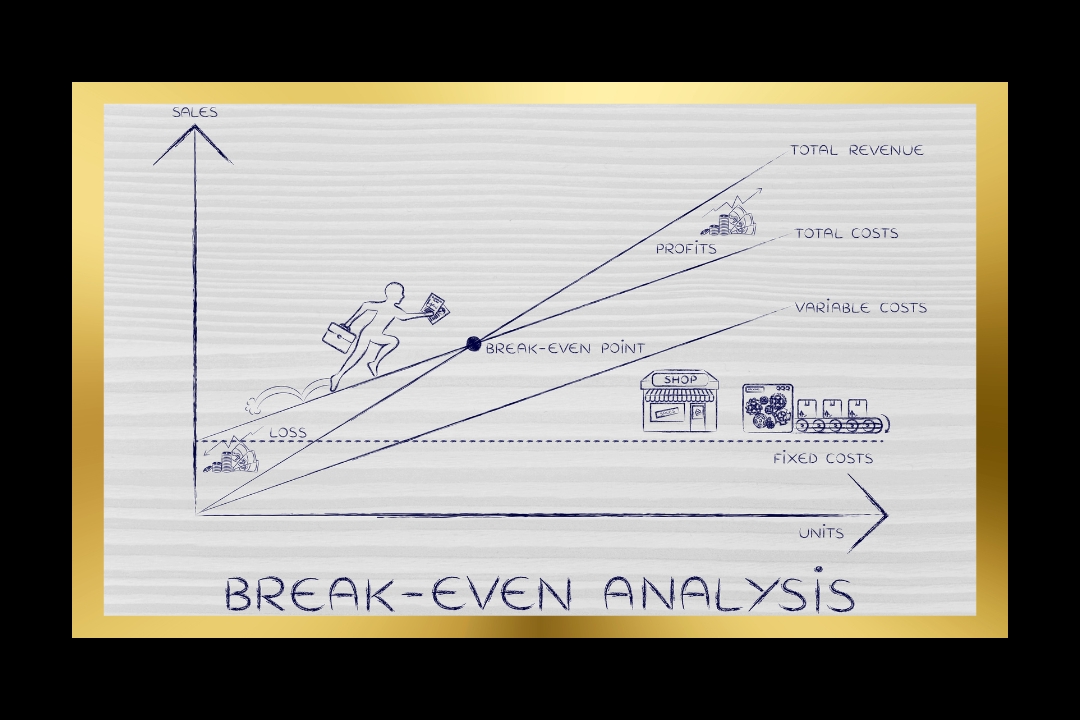
Understanding your business breakeven point is essential to know how much money you need to make to stay in business. It can therefore help you make well-informed financial decisions and practical business plans.
The breakeven point is the income or sales needed to cover all costs. Any earnings above this point generate profit. So your breakeven point tells you the minimum sales required to continue operating a viable business.
Understanding the breakeven point in conjunction with financial reports can give you valuable data to analyse fixed and variable costs and set sales targets for the business or individual staff members.
Fixed and Variable Costs
Fixed costs – remain the same regardless of how many sales you make. Expenses like rent, equipment lease repayments, or full-time staff must be paid whether you sell any goods or services or not. Fixed costs are often called overheads.
Variable expenses – (sometimes called production costs) fluctuate based on sales. For example, the cost of goods sold, production labour, and commissions paid to salespeople will vary according to the number of goods or services sold.
It’s helpful to work out an amount or percentage of variable costs compared to the sale price of your products or service. This may not be exact initially, but even if you get a rough figure to work with, this will help calculate your breakeven point. Over time as you analyse your financial reports, you’ll be able to refine the calculation and adjust your selling price accordingly.
How to Calculate Breakeven
You’ll need to know your fixed costs (overheads), selling price, and production costs.
One common method of calculating breakeven is as follows:
Overheads / (selling price – production cost)
For example, let’s say monthly overheads (rent, vehicle lease, administration staff) are $20,000, and you sell a coaching program for $3,000 with variable costs (coach fees, handout materials for participants, advertising) of $1,500 per program.
$20,000 / ($3,000 – $1,500) = 13.33
You would need to sell over 13 programs per month to break even, which equates to $40,000 worth of sales.
If the same program had variable costs of $1,800, you would need to sell 17 programs per month to generate $50,000 worth of monthly sales just to cover costs. Variable costs of $1,000 per program would mean you only need to sell 10 per month to break even.
With these examples, you can see how important it is to understand your fixed and variable costs. Then you’ll know exactly how much you need to make to remain in business and the resulting impact on your financial position. Once you have a reasonably accurate breakeven figure, you can quickly calculate your profit before tax for sales above the breakeven point. In the example where variable costs are $1,500 per program, let’s say you sell 20 programs each month. This would result in an extra $10,000 in profit (before tax) after paying for overheads and variable costs.
Can breakeven help with your pricing?
Understanding your breakeven point can give you some deep insights into your selling prices, helping you understand if they’re realistic.
For example, if your variable costs are high, how much more income will you need to reach breakeven? Is there a fair price for consumers that covers your expenses in a reasonable time frame? Do you need to raise prices to account for fixed and variable costs accurately?
Talk to us about calculating your breakeven point
There are different ways of calculating your breakeven point to confirm the viability of your business and the ideal pricing point for driving both sales and profitability.
We’d love to help you understand your business financials in more depth so that you can plan for long-term sustainability, enjoyment, and profitability.
Starting from the 2023 financial year, there are new rules for keeping records and calculating deductions for people who are working from home. There are now two ways to work out your deductions: the actual cost method and the revised fixed rate method. The revised fixed rate method has been changed to make it easier for people to calculate their expenses and avoid complicated calculations.
Using the revised fixed rate method, you can claim 67 cents for every hour you work from home. This covers things like; electricity, gas, phone and internet usage, computer consumables, and stationery. You can also claim the work-related portion of any equipment you bought for your home office, like furniture or technology.
You don’t need to have a dedicated home office space to use the revised fixed rate method, and businesses that operate from home can also use it to claim home-based business expenses.
To use the revised fixed rate method, you must keep a record of the total number of hours you worked from home, as well as evidence that you paid for the expenses covered by the fixed rate method, like phone or electricity bills. You also need records for any equipment you bought to work from home.
Please feel free to download and use the document below to record the hours you worked from home.
New rules for tax deductions on working from home expenses from the 2023 financial year.
Dedicated workspace no longer required to claim deductions.
Depreciation on work assets such as office furniture and technology can be claimed.
Two calculation methods are available: actual cost method and revised fixed rate method.
Revised Fixed Rate Method Highlights
Expenses covered under the revised fixed rate method: electricity, gas, phone, internet, computer consumables, and stationery.
Rate for revised fixed rate method increased from 52 cents to 67 cents per hour worked from home.
Businesses that operate from home can also use the revised fixed rate method.
To use revised fixed rate method, records of hours worked and expenses.
If you have worked from home during the 2024 financial year, contact us to discuss your situation further as you are likely to be affected by the above changes.
Additional Resources:
ATO Instructions for claiming deductions using the revised fixed rate method or actual cost method, click here.