Navigating New Horizons: Changes to How Tax Practitioners Work with Clients
The landscape of tax advice and compliance in Australia is undergoing significant change. The Government has introduced new legislation that impacts how tax practitioners engage with their clients. This follows revelations of unethical behaviour within the industry. These changes are designed to protect the integrity of the tax system. They ensure that both tax practitioners and their clients adhere to the highest standards of ethical conduct. For businesses and individuals alike, understanding these reforms is essential to maintaining a compliant and transparent tax strategy.
A New Era in Tax Compliance: Understanding the Legislative Changes
The amendments to the Tax Agent Services Act 2009 are a direct response to the recommendations of a Senate enquiry. This investigated the conduct of accounting giant, PwC. The enquiry was prompted by a scandal involving a former PwC Partner who leaked confidential Treasury information. This allowed clients to circumvent proposed anti-avoidance tax laws. This breach not only threatened an estimated $180 million in annual tax revenue but also exposed significant gaps in the regulation of tax practitioners and their interactions with clients.
In response, the Government has enacted legislation that introduces stricter obligations for registered tax practitioners. These changes include mandatory reporting of material uncorrected errors to the Tax Commissioner and increased transparency around practitioner registration and the management of client complaints. For clients, these reforms mean greater protection and assurance that their tax affairs are being handled with integrity and professionalism.
The Compulsory Reporting of Material Uncorrected Errors
One of the most significant changes introduced by the new legislation is the compulsory reporting of material uncorrected errors. Under the updated framework, tax practitioners are now legally required to report any material errors or omissions that have not been corrected to the Tax Commissioner. This applies whether the error was made by the practitioner or the client.
If a tax practitioner finds a previous statement to the Tax Commissioner incorrect, they must promptly correct it. If the client made the error, the practitioner must inform them to rectify it. Should the client refuse or fail to fix the error, the practitioner must report it to the Tax Commissioner.
This change closes a loophole that previously let tax practitioners overlook errors without consequences. Stricter reporting requirements ensure both tax practitioners and clients are accountable for accurate tax reporting.
Strengthening the Integrity of the Tax Profession
The PwC scandal highlighted not only the potential for unethical behaviour within the tax profession but also the shortcomings in the existing regulatory framework. As part of the Government’s response, the powers of the Tax Practitioners Board (TPB) have been bolstered, giving it greater authority to investigate and penalise misconduct.
Tax practitioners are now required to regularly demonstrate the currency of their registration with the TPB. Clients are encouraged to check the registration status of their tax practitioner through the public register maintained by the TPB. This register provides peace of mind, ensuring that only licensed professionals are providing tax or BAS services.
For example, DJ Grigg Financial is fully registered with the TPB, with registration number 24857604. Clients can easily verify this registration via the public register to confirm they are working with a legitimate and compliant practitioner. You can check the public register here: https://www.tpb.gov.au/public-register
Managing Client Complaints: A Transparent Process
The new legislation also places an emphasis on transparency in the management of client complaints. Tax practitioners must now clearly communicate to clients how they can lodge a complaint if they are dissatisfied with the services provided. This ensures that clients have a clear and accessible pathway to raise concerns, fostering greater trust between practitioners and their clients.
At DJ Grigg Financial, we are committed to delivering quality services that meet our clients’ expectations. However, should a client feel that their expectations have not been met, they are encouraged to contact our office directly. If the issue cannot be resolved to the client’s satisfaction, they have the right to escalate the matter to the TPB. This two-tiered complaints process ensures that all clients have their concerns addressed in a fair and transparent manner.
Expert Insights: The Impact of Legislative Reforms
Industry experts highlight the importance of these legislative changes in restoring public trust in the tax profession. Dr. Michelle Carey from the University of Melbourne says the reforms address critical weaknesses in tax practitioner regulation. Stricter reporting obligations and stronger TPB powers ensure tax practitioners operate with high integrity standards.
Andrew Mills, former ATO Second Commissioner, calls the changes a wake-up call for the industry. Tax practitioners must now ensure their advice is accurate and ethical. Clients must understand new obligations and choose practitioners who uphold these standards.
The Benefits for Clients: Transparency, Accountability, and Trust
While these changes may seem daunting at first, they ultimately offer significant benefits for clients. The enhanced regulatory framework provides greater transparency, ensuring that clients are fully informed about the status of their tax practitioner’s registration and their rights in the event of a complaint. The compulsory reporting of material uncorrected errors further protects clients by ensuring that any inaccuracies in their tax returns are promptly addressed, reducing the risk of penalties or audits.
For business clients, these changes also reinforce the importance of engaging with a tax practitioner who is both knowledgeable and trustworthy. In an increasingly complex tax environment, having a practitioner who is committed to ethical conduct and compliance with the law is essential for long-term financial success.
Adapting to the New Normal: What Clients Need to Know
As the tax landscape continues to evolve, it is crucial for both businesses and individuals to stay informed about the changes and how they impact their relationship with their tax practitioner. Here are some key takeaways for clients:
Verify Your Practitioner’s Registration: Always ensure that your tax practitioner is registered with the TPB by checking the public register. This confirms that they are licensed to provide tax or BAS services and are subject to the new regulatory requirements.
Understand the Complaints Process: Familiarise yourself with the complaints process offered by your tax practitioner. If you are not satisfied with their services, you have the right to escalate your complaint to the TPB.
Be Proactive About Correcting Errors: If your tax practitioner identifies an error in your tax return, work with them to correct it promptly. Remember that if the error is not corrected, your practitioner is obligated to report it to the Tax Commissioner.
Engage with Ethical Practitioners: Choose a tax practitioner who prioritises ethical conduct and compliance with the law. The recent reforms underscore the importance of working with professionals who are committed to maintaining the highest standards of integrity.
Conclusion: Embracing Change for a Stronger Future
The changes to how tax practitioners work with clients mark a significant shift in the Australian tax landscape. While these reforms have been driven by a need to address serious misconduct within the industry, they also present an opportunity to strengthen the relationship between practitioners and clients. By embracing these changes and understanding the new obligations, clients can ensure that their tax affairs are managed with the utmost professionalism and transparency.
At DJ Grigg Financial, we are committed to guiding our clients through this new era of tax compliance. If you have any concerns or would like more information about how these changes may affect you, please do not hesitate to contact us. Together, we can navigate these changes and secure a stronger financial future for all.
Understanding the Main Residence Exemption and Capital Gains Tax
As the character of Darryl Kerrigan in The Castle said, “it’s not a house. It’s a home.” This sentiment resonates deeply with many Australians. But when it comes to taxes, the distinction between a house and a home can have significant financial implications. The main residence exemption is a vital aspect of Australia’s tax system. It offers homeowners relief from capital gains tax (CGT) when they sell their principal residence. However, as with all tax matters, the details can be complex. This article explores the intricacies of the main residence exemption. It will provide homeowners with essential information to navigate this aspect of the tax system effectively.
What is the Main Residence Exemption?
The main residence exemption allows homeowners to avoid paying CGT on the sale of their family home. To qualify for this exemption, the property must be considered your main residence. The Australian Taxation Office (ATO) uses several criteria to determine whether a property qualifies:
It is where you and your family live.
Your personal belongings have been moved into the dwelling.
It is where your mail is delivered.
It is your address on the electoral roll.
You have connected services such as telephone, gas, and electricity in your name.
It is your intention for the home to be your main residence.
While the length of time you have lived in the home is important, your intention takes precedence, as every situation is different.
When Does the Main Residence Exemption Apply?
Generally, CGT applies to the sale of your home unless you qualify for an exemption, partial exemption, or can offset the tax against a capital loss. If you are an Australian resident for tax purposes, you can access the full main residence exemption when you sell your home if:
Your home was your main residence for the entire time you owned it.
You did not use your home to produce any income.
The land your home is on is 2 hectares or less.
Partial Exemption
If you have used your home to produce income, you might not be able to claim the full main residence exemption, but you might still qualify for a partial exemption. Common scenarios impacting your main residence exemption include running a business from home or renting out part of the home. From the time you started using the home to generate income, that part of the home is likely subject to CGT.
“With the rise of platforms like Airbnb, it’s essential for homeowners to understand their tax obligations. As of 1 July 2023, these platforms must report all transactions to the ATO every six months,” notes John Smith, a tax expert.
Foreign Residents and Changing Residency
Foreign residents cannot access the main residence exemption, even if they were residents for part of the time they owned the property. If you are a non-resident at the time you enter into the contract to sell the property, you are unlikely to qualify for the exemption. Conversely, if you are a resident at the time of the sale and meet the other eligibility criteria, you should be able to access the exemption, even if you were a non-resident for some of the ownership period.
The Absence Rule: Can the Main Residence Apply If You Move Out?
The absence rule allows you to continue treating your home as your main residence for tax purposes:
– For up to 6 years if the home is used to produce income.
– Indefinitely if it is not used to produce income.
Applying the absence rule to your home normally prevents you from applying the main residence exemption to any other property you own during the same period.
“The six-year rule can be a lifesaver for expats or those temporarily relocating. It allows them to maintain their main residence exemption while renting out their home,” explains Sarah Brown, a financial advisor.
Timing and the Main Residence Exemption
Your home typically qualifies as your main residence from the point you move in and start living there. However, if you move in as soon as practicable after the settlement date of the contract, that home is considered your main residence from the time you acquired it.
If you buy a new home but haven’t sold your old home, you can treat both properties as your main residence for up to six months without impacting your eligibility for the main residence exemption. This applies if the old home was your main residence for a continuous period of three months in the 12 months before you disposed of it and you did not use your old home to produce income during that period.
Special Cases: Couples and Divorce
Couples with Two Homes
If you and your spouse each own homes that you have separately established as your main residences, the rules do not allow you to claim the full CGT exemption on both homes. Instead, you can:
– Choose one of the dwellings as the main residence for both of you during the period.
– Nominate different dwellings as your main residence for the period.
If you nominate different dwellings, the exemption is split between you based on ownership percentages.
Divorce and the Main Residence Exemption
In the case of divorce, if the home is transferred to one of the spouses and both individuals used the home solely as their main residence over their ownership period, a full main residence exemption should be available when the property is eventually sold. If the home qualified for the main residence exemption for only part of the ownership period for either individual, then a partial exemption might be available.
Conclusion
The main residence exemption offers significant tax relief for homeowners. But understanding the specific rules and conditions is crucial to maximising this benefit. From ensuring your home qualifies as your main residence to navigating the complexities of partial exemptions, foreign residency, and special cases like divorce, staying informed is key.
Expert Tip: Navigating the main residence exemption requires more than just a basic understanding. Homeowners should seek professional advice to ensure they are fully compliant and making the most of available tax benefits.
For more detailed information, visit the ATO website or consult with a tax professional to ensure your tax return accurately reflects your circumstances and maximises your eligible exemptions.
ATO Crackdown: Rental Property Owners & Tax Returns
As we are now past the end of financial year, rental property owners must be more vigilant than ever in ensuring their tax returns are accurate and compliant. The ATO continues to focus on inflated claims to offset increases in rental income, with many property owners still making mistakes despite using registered tax agents. This article will guide you through the common pitfalls, offer expert advice, and provide practical steps to stay compliant with the ATO’s requirements.
Why the ATO is Focusing on Rental Property Owner’s Tax Returns
The ATO has flagged rental property owner’s tax returns as a primary area of scrutiny due to ongoing errors in reporting. Common mistakes include overclaimed deductions, inadequate documentation, and misunderstanding which expenses can be claimed and when. The ATO’s data shows that the majority of rental property owners are still getting it wrong, leading to a closer examination of these tax returns.
“Rental property owners need to be meticulous with their record-keeping and fully understand the expenses they can claim,” says ATO Assistant Commissioner Tim Loh. “Failing to do so can result in disallowed deductions and potential penalties.”
Common Mistakes Made by Rental Property Owners
Overclaimed Deductions
One of the most frequent errors is overclaiming deductions. This can happen when property owners:
– Claim personal expenses as rental expenses
– Include the full amount of shared costs without apportioning them appropriately
– Claim repairs and maintenance costs that are actually capital works
Inadequate Documentation
The ATO requires thorough documentation to substantiate all claims. Common documentation issues include:
– Missing receipts or invoices
– Incomplete records of rental income and expenses
– Lack of evidence to support the work done on the property
Misunderstanding Claimable Expenses
Another significant mistake is not understanding what expenses can be claimed and when. The difference between repairs or maintenance and capital expenditure is particularly confusing for many property owners.
ATO’s Methods for Ensuring Compliance
To ensure accuracy, the ATO cross-checks data from various sources, including banks, land title offices, insurance companies, property managers, and sharing economy providers. This comprehensive approach helps the ATO identify discrepancies and enforce compliance.
PRO TIP: The ATO’s ability to cross-check information means that rental property owners need to be diligent and precise in their tax reporting.
Expert Advice on Staying Compliant
Keep Accurate Records
Maintaining detailed and accurate records is crucial for substantiating your claims. This includes:
– Keeping all receipts and invoices for expenses related to your rental property
– Maintaining a logbook of all income and expenses
– Documenting any repairs, maintenance, or capital works
PRO TIP: Accurate record-keeping is the foundation of a compliant tax return. It ensures you can substantiate every claim you make.
Understand Claimable Expenses
Knowing what expenses you can claim is essential to avoid overclaiming or missing out on legitimate deductions. Expenses can generally be claimed only to the extent that they are incurred in producing rental income. This means costs incurred in generating rental income annually may be claimed for that period.
Repairs and Maintenance vs. Capital Expenditure:
– Repairs and Maintenance: Costs to restore something to its original condition or ensure it continues to function. These can be claimed in the year they are incurred.
– Capital Expenditure: Costs for improvements or enhancements that add value to the property. These must be depreciated over several years.
PRO TIP: Understanding the difference between repairs and capital expenditure is crucial. Many property owners mistakenly claim capital improvements as repairs, leading to disallowed deductions.
Work with Your Tax Agent
If you use a tax agent, it’s vital to communicate all relevant information about your rental property. This ensures your tax return is prepared accurately and all claims are legitimate.
PRO TIP: Your tax agent can only work with the information you provide. Be proactive in sharing all details about your rental property to avoid mistakes.
Conclusion
The ATO’s crackdown on rental property owner’s tax returns underscores the importance of accuracy and compliance. By keeping detailed records, understanding claimable expenses, and working closely with your tax agent, you can ensure your tax return is correct and avoid potential penalties.
Staying informed and proactive is key to navigating the complexities for rental property owner’s tax returns. Make sure you are up to date with the latest ATO guidelines and take the necessary steps to ensure compliance. By doing so, you can maximise your eligible deductions and avoid the pitfalls that many rental property owners face.
Additional Resources
For more detailed information, visit the ATO website where you can find comprehensive guides for rental property owners, as well as tools and calculators to help you determine the correct expenses to claim.
ATO Crackdown: Claiming Working from Home Related Expenses Correctly
With the ATO intensifying its scrutiny on incorrectly claimed work-related expenses, particularly for those working from home, it’s crucial to understand the right way to claim deductions. As tax time 2024 is here, taxpayers must ensure they are accurately identifying and claiming work-related expenses to avoid penalties. This article provides a comprehensive guide on how to navigate these claims correctly, ensuring you stay compliant and maximise your eligible deductions.
Why the ATO is Focusing on Work-Related Expenses
Claiming work-related expenses is an area rife with errors, making it a primary focus for the ATO this tax season. In 2023, more than eight million taxpayers claimed a work-related deduction, with about half relating to working from home costs. The increase in remote work has made understanding the methods for calculating these deductions more critical than ever.
“Copying and pasting your working from home claim from last year may be tempting, but this will likely mean we will be contacting you for a ‘please explain’,” says ATO Assistant Commissioner Rob Thomson. “Your deductions will be disallowed if you’re not eligible or you don’t keep the right records.”
Methods for Calculating Working from Home Expenses
There are two primary methods for calculating work from home expenses: the actual cost method and the fixed rate method. It’s important to choose the one that best suits your situation, as these methods cannot be combined.
Actual Cost Method
This method involves calculating the precise cost of expenses incurred while working from home. This includes costs such as:
– Electricity and gas for heating, cooling, and lighting
– Home office equipment and furniture depreciation
– Internet and phone expenses
To use the actual cost method, you must keep detailed records of all expenses and the portion of these costs that relate directly to your work.
Fixed Rate Method
The fixed rate method allows you to claim a set rate of 67 cents per hour for work from home expenses. This covers:
– Running costs like electricity and gas
– Phone and internet expenses
– Home office equipment depreciation
Like the actual cost method, detailed records of hours worked from home and evidence of expenses are essential.
The ATO’s Three Golden Rules
Regardless of the method you choose, the ATO has three golden rules for claiming work-related expenses:
1. You must have spent the money yourself and not been reimbursed.
2. The expense must be directly related to earning your income.
3. You must have a record to prove the expense.
These rules are designed to ensure that only legitimate work-related expenses are claimed. Failure to adhere to these rules can result in your claim being disallowed.
Eligibility for Claiming Working from Home Expenses
To be eligible to claim working from home expenses, you must meet specific criteria:
– Fulfill Employment Duties: You must be performing your employment duties while working from home, not just minimal tasks like taking calls or checking emails.
– Incur Additional Running Expenses: You should have additional expenses due to working from home, such as increased electricity or gas costs.
– Keep Detailed Records: Maintain detailed records showing how these expenses were incurred and how they relate to your work.
Expert Advice on Claiming Work From Home Expenses
Keep Accurate Records
One of the most common mistakes is failing to keep accurate records. This includes:
– Receipts and invoices for all claimed expenses
– A logbook or diary showing hours worked from home
– Evidence of how you calculated the work-related portion of expenses
PRO TIP: Keeping meticulous records not only ensures compliance but also maximises your eligible deductions.
Choose the Right Method
Selecting the appropriate method for your situation is crucial. The actual cost method can result in higher deductions if you have significant running costs, but it requires more detailed record-keeping. The fixed rate method is simpler but might not capture all your expenses.
PRO TIP: Evaluate your work from home setup and expenses carefully before deciding which method to use.
Avoid Common Pitfalls
Many taxpayers fall into the trap of over-claiming or including non-deductible expenses. Common errors include:
– Claiming the entire internet or phone bill without apportioning the work-related usage
– Including expenses for household members
– Claiming expenses for minimal tasks not directly related to earning income
PRO TIP: It’s easy to overestimate deductions without realising it. Ensure you only claim what is directly related to your work.
Statistics on Work-Related Deductions
The ATO’s increased focus on work-related deductions is backed by significant statistics:
– Over 8 million taxpayers claimed a work-related deduction in 2023.
– 50% of these claims were related to working from home costs.
– Incorrect claims result in millions of dollars in adjustments each year.
These figures highlight the importance of getting your work-related expense claims right. By adhering to the ATO’s guidelines and keeping detailed records, you can avoid the risk of penalties and ensure your deductions are maximised.
Conclusion
As the ATO intensifies its crackdown on incorrectly claimed work-related expenses, especially for those working from home, it’s vital to understand the correct methods for claiming deductions. By following the ATO’s guidelines, keeping accurate records, and choosing the appropriate calculation method, you can navigate tax time with confidence and compliance.
Stay informed, stay diligent, and make sure your work-related expense claims are accurate and justified. Doing so will not only keep you on the right side of the ATO but also ensure you receive the deductions you’re entitled to.
Additional Resources
For more detailed information, see this article, or visit the ATO website where you can find comprehensive guides on claiming work-related expenses, as well as tools and calculators to help you determine the best method for your situation.
Stay Safe This Tax Season: Guard Against Rising Tax Scams
As tax season approaches, business owners and employees alike need to be vigilant against a rising tide of tax time scams. Despite the proactive measures taken by the Australian Taxation Office (ATO) and the National Anti-Scam Centre (NASC), fraudsters continue to find new ways to deceive unsuspecting taxpayers. With a notable increase in ATO impersonation scams reported in recent months, it’s crucial to understand the tactics scammers use and how to protect yourself. This article delves into the prevalent scams, offers expert advice, and provides practical steps to avoid becoming a victim.
The Rise of ATO Impersonation Scams
Recent data indicates a troubling 31% increase in reports of ATO impersonation scams through various channels such as SMS, email, phone, and social media as tax time approaches in 2024. These scams often involve unsolicited contact where fraudsters pose as ATO representatives offering refunds, assistance with tax issues, or alerting taxpayers to suspicious activity on their accounts.
Despite the efforts of the ATO and NASC, which have resulted in over 5,000 fraudulent website takedowns and the blocking of 100 million scam text messages in the last quarter of 2023, scammers continue to evolve their tactics. This persistence underscores the need for heightened awareness and caution during tax season.
Understanding the Tactics of Scammers
Scammers use a variety of methods to trick taxpayers into divulging personal information or transferring money. Some common tactics include:
– Phishing Emails and SMS: These messages often contain links to fake websites designed to steal personal information or install malware. The ATO has responded by removing hyperlinks from all outbound unsolicited SMS to prevent such scams.
– Phone Scams: Scammers might call, posing as ATO officials, and create a sense of urgency, demanding immediate payment to avoid penalties or legal action.
– Social Media Scams: Fraudsters may use social media platforms to contact individuals directly, offering tax refunds or threatening legal consequences.
Real Stories, Real Risks
Consider the case of John, a small business owner who received an email that appeared to be from the ATO, claiming he was due for a significant tax refund. Excited, he clicked the link and entered his personal and financial details. A week later, John discovered his bank account had been drained, and his personal information was used to open fraudulent accounts in his name.
Unfortunately, John’s story is not unique. Many individuals and businesses fall victim to similar scams each year, highlighting the importance of vigilance and education.
Expert Advice: How to Avoid Tax Scams
Be Skeptical of Unsolicited Contact
The ATO emphasises that they will never contact you through unsolicited email, SMS, or social media to ask for personal information or payment. If you receive such a message, do not engage. Instead, look up the ATO’s official contact numbers and verify the communication.
“Always verify unsolicited contact independently. Scammers often create a sense of urgency, but taking a moment to verify can save you from significant losses,” advises Sarah Johnson, cybersecurity expert at SecureNet Solutions.
Check for Authenticity
When in doubt, visit the ATO website directly. The ATO provides detailed information about ongoing scams and how to recognise them. They also offer a reporting service for any suspicious communication.
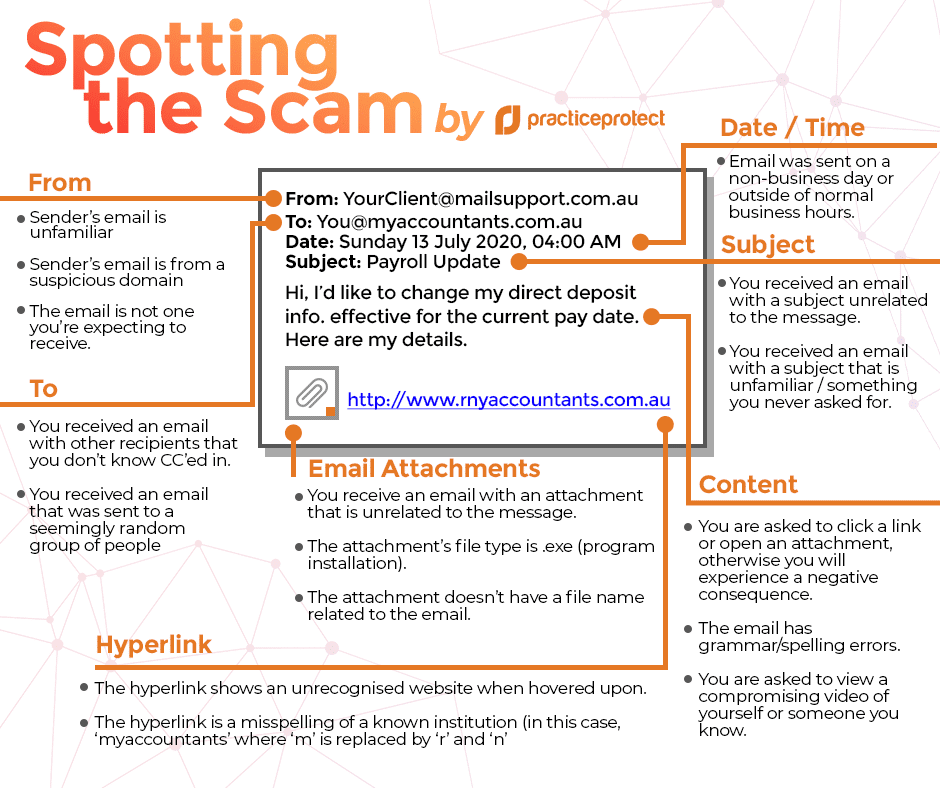
We’re attaching here, an Infographic put together by our Cybersecurity partner Practice Protect. This infographic highlights how you can spot an email scam.
“Legitimate organisations like the ATO will have secure methods for contacting you. Be wary of any communication that deviates from their standard procedures,” says Mark Harris, a fraud prevention specialist.
Use Strong Cybersecurity Practices
Ensure your devices are protected with up-to-date antivirus software, and be cautious about the information you share online. Regularly update your passwords and use two-factor authentication whenever possible.
“Cybersecurity is an essential layer of defense against scams. Protecting your digital footprint can prevent scammers from accessing sensitive information,” states Emily White, IT security consultant.
Proactive Measures by Authorities
The ATO and related authorities are continually working on new measures to combat scams. The creation of NASC and funding for the Australian Securities and Investments Commission (ASIC) and the Australian Communications and Media Authority (ACMA) to take down fake investment websites are steps in the right direction. The establishment of the SMS Sender ID register to stop scammers from spoofing trusted brand names has also been effective.
In addition, the ATO has a dedicated team monitoring for scams and assisting victims. They offer comprehensive resources and guidelines on their website to help the community recognise and report scams.
Statistics and Success Stories
The efforts of the ATO and NASC have led to significant achievements in scam prevention:
– Over 5,000 fraudulent websites were taken down in the final quarter of 2023.
– More than 100 million scam text messages were blocked during the same period.
– 31% increase in reports of ATO impersonation scams in May 2024 highlights the ongoing battle against scammers.
These statistics underscore the importance of remaining vigilant and the positive impact of coordinated efforts to combat fraud.
Conclusion
Tax time is a critical period for business owners and employees, making it a prime target for scammers. By staying informed about the latest tactics used by fraudsters and following expert advice, you can protect yourself and your business from falling victim to tax time scams. Remember to verify unsolicited contacts, check for authenticity, and practice robust cybersecurity measures. The collective effort of individuals and authorities is key to mitigating the risks posed by these persistent scams.
Understanding the Basics: Business Asset Depreciation
Business asset depreciation is what happens when business assets lose value over time.
It’s an often-forgotten cost of doing business – but it shouldn’t be. Here’s why depreciation is so important:
Costs you money – Depreciation accounting involves calculating how much value your assets lose each year. It can be listed as a loss and subtracted from your revenue.
Can reduce your tax bill – Because depreciation is a business cost, it can lower your tax bill. That’s why it’s important to know how much value you’re losing each year.
Affects the value of your business – If major business assets lose value, the overall value of your business is reduced. Inaccurate tracking could lead to overestimating your business value, making it harder to secure finance.
The ins and outs of business asset depreciation
Usually, only long-term or fixed assets can be depreciated, while consumable products aren’t included.
You also need to estimate the item’s lifespan and choose a method to calculate how its value declines over time.
Common methods include:
Straight line depreciation: the asset depreciates by the same amount each year, eventually reaching zero value.
Diminishing value depreciation: the value declines by a higher percentage in the first few years, then the rate of depreciation slows.
Units of production depreciation: the lifespan is calculated by the value delivered, not the time spent using the asset. For example, a business vehicle’s depreciation might be measured in kilometres travelled rather than age.
Accounting for depreciation in your business
When you’re just starting out, calculating depreciation can seem overwhelmingly complex. But, because it can lower your costs and help you track your business value, it’s worth making the effort.
If you’re not sure where to start, click here to get help from our expert accounting team now.
For more on our ‘Understanding the Basics’ series, see: